Búsqueda personalizada

sábado, 18 de abril de 2009

Los espejos miran de lejos

Pattyo de recreo


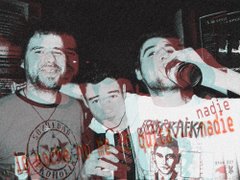
Reyes me procura cubitos de hielo de ron y sidra muy me-conmigo
y yo me los trago (pero que conste que todo es muy por no hacerle el feo
ya que garganta es de sus palabras preferidas
y yo me dedico a ellas con mi voz de tubería a cuestas, así granate tirando a menta)
y Patty lucha contra discos rallados imposibles entre revolución y revolución
cantando siempre, que me encanta que cantes, que te encanta que me encante
que ya lo sé, que yo a ti más, que Patty y Silvi, que qué bonito
que porque sin music ni soy ni quiero ser, ni entiendo la mitad de las cosas
y es que estas tías no permiten que me farte de nah, asíke vuelvo

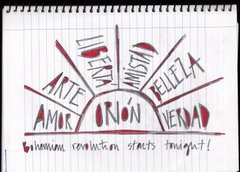
siempre pinto lo de Orión en la arena
y saludo a Ross y a Rachel con friends-entusiasmo
y miro a ver si Jana me deja acariciarla, y me deja
y estoy de rodillas, como los fieles, checkeando lo que editas
y estoy a la deriva, pero ahi arriba, como que camino sobre las aguas

porque vale, mira, vale, son 93 escalones
atrévete de borrachera
atrévete al 3 en raya, 25 horas diarias, el ombligo de mi mundo
a llorar a la Vía Láctea

es mi pattyo de recreo
fortuna, mtv, móviles sonando
se grita mogollón rascando el cielo
he gemido, he llorado, he destrozado
he encontrado y perdido el sentido del tiempo, me he mareado
me han echado

la luz se filtra por los tragaluces del techo
un escritorio en el que jamás se escribe a mano
teclado que come nueces para hacer cosquillas en las costillas de debilitarnos
teclado progenitor de Lola y barbaridades varias del sirio
sin el que no-reímos, y como que menos somos

un fregadero totalmente abandonado
una pijadita nueva para tiras las cañas que superafavor
un cuarto de baño que lo mismo nos sirve de escenario
una habitación de carcajadas naranjas más que cómplice de que rima
y desde luego unos muebles, que como Marilyn, saben demasiado

una exaltación del ser o no ser ahora mismo wait a minute honey que la están peinando
always el horno para bollos my friend in the neighbourhood
always abrazos comunes descomunales
BUKOMUNA is in the building
y quiere más, y se lo damos

hay cosas con las que no se juega, y aun así jugamos
sentimientos desbordados, claustrofobia vitalicia, maratón emocional
la seriedad es un invento poco serio
para los ejemplares tarados de la serie… y aun así jugamos,
hay más bares - hay más casas - hay más guapas, te lo juro, las he visto
y aun así seguimos jugándonosla
con folios en plena sobredosis de hoja perenne

Me gusta su olor y que no tenga horarios
siempre pinto lo de Orión en la arena (x3)
y es un canteo,
como pronunciar el término o’clock en vano sin 2de de frente,
como atreverte a escribir la palabra cerveza en poemas sin rozar alcoholismos,
como la sinceridad de palo rozando la impertinencia al compararse
como días de viento que taladra con su metralla de pureza esquiva,
como que qué cómodo es que estas dos ya estén acostumbradas a acostumbrarse
a que soy así y sepan vivirme,
como que entre mis letras se cuchichee que hay favoritismos con la Y griega
porque es la que os une y lo sabemos
como que patapán-chin concretado en menos mal que tú m’entiendes
como que nunca se sepa qué va a pasar y a la vez todo haya pasado ya porque hay a quienes nos rima y quienes estamos destinadas

como que si esas paredes hablasen, lo que dirían sería:
os estáis pasando


Los espejos miran de lejos
http://www.youtube.com/watch?v=G4siU73PqWA&feature=channel_page

jueves, 9 de abril de 2009

José "caleteador" Alegre

Fue un momentazo, y me hizo una gran ilusion, tu regalo de el librito de la enciclopedia pulga,"las hazañas de los aficionados a la astronomia", para que veas hasta que punto, sin tu saberlo quiza toco aquello mis fibras mas sensibles y a modo de agradecimento, ahi va este poema , o lo que sea, un poco largo, ya lo leeras , cuando encuentres tiempo si quieres y no hay prisa... ojala te guste.. tan ambicioso (como suele ocurrir) como poco logrado...
En fin, salio asi, espero y que te guste, Silvi. Y con cariño....

sábado 4 de abril de 2009

-"ORION II"(REGALO DE UN DOS DE ABRIL)"-

Quiero el poema mas poderoso para el sentimiento mas poderoso.
Hay cosas que son mas nuestras que ninguna, que nada, que nadie.
Forman parte de nuestra raiz, de nuestra esencia, del fundamento mismo
de nuestro ser.
Del comienzo.
Desde que comence a hacerme preguntas.
y pienso en ti
contandome de mi para siempre querido -Sinuhe-
que se preguntaba porque....
y pienso en la pregunta porqueque siempre he pensado
que no hay cosa alguna que pueda llevarme mas lejos.

Pero de entre todas las cosas,
de entre todos los recuerdos
lejanos y cercanos,
ninguno tan vivido,
tan en el corazon,
como tu enseñandole
al niño que yo fui
al niño que queda
inextingible en el corazon:

Las estrellas...

Nada hay mas de fuego,
nada hay mas luminoso para mi,
emocionante, tierno, arrebatador...
nada me hace viajar mas lejos.

Y de entre todos los recuerdos de las estrellas,
de entre todas las noches estrelladas,
uno , tu enseñandome
La Constelacion de Orion,
todo esto se pierde en mi noche de los tiempos,
la fantasia se mezcla con la realidad,
pero creo que si,que fue asi
tu diciendome:
Las tres marias: El cinturon de Orion.
si, creo que si, señalandome
las tres marias al frente ,
altas en el cielo,
la noche, el campo, la tierra oscura.
Tu y yo , unidos por una vez,
y de ahi surgen poderosas sus cuatro compañeras:
Betelgeuse, Rigel ,Bellatrix, Saiph.

Cuantas veces no he mirado yo el cielo,
y te he encontrado ,vieja amiga,
constelacion eterna.
De ti, la mas brillante
surge el cielo, y toda la escondida via lactea.
Cuantas veces no he mirado yo el cielo
buscando toda la paz del mundo.
todo el sentido del mundo,
toda la trascendencia del mundo, buscando una guia,
algo que me ayudara...
Y como por instinto te he buscado.
Inmensa constelacion de Orion,
de las mas refulgentes estrellas;
Puente del Cielo.

Toda nuestra incomprension,
no puede borrar toda la fuerza de este recuerdo.
Cuantas cosas no he volcado yo en Orion.
Nuestra incomprension
pero queriendonos.
Mar y yo pero queriendonos.
Ana y yo pero queriendonos.
Todo el amor perdido y sin meta
¿A donde va?
yo interrogo a las estrellas...
por algun motivo ellas,
su luz se toma el trabajo de venir hasta nosotros,
¿que busca la luz en el espacio?
¿Porque se empeña La Constelacion de Orion en estar tan firme en el cielo?

Igual tambien nosotros con nuestra mirada,
con nuestros anhelos infinitos,
le devolvemos algo a ellas,
todo ese amor sin meta,
cosas perfectas e inolvidables
sobre las que va cayendo el olvido.

Pero estan ahi,
en los recovecos de nuestro corazon,
esperando tal vez un abrete sesamo o un abracadabra,
o el momento de nuestra muerte
en que segun dice se liberan
el tiempo se para y pasa toda nuestra vida.

O tal vez viajan a traves del universo.
Yo envio a Orion una carta,
con cuanto voy viviendo para que ahi me esperen,
sobre todo la incomprension,
lo que no comprendo.

Yo quisiera vivirlo todo.
comprenderlo todo y no olvidar nada.
Asi me aferro yo a la vida con todas mis fuerzas.
El recuerdo de mi padre mostrandome la constelacion de Orion
en la raiz misma de mi ser.

Orion siempre ha sido mi calida constelacion protectora.

-----------------------------------

No se de donde los saco,
No habia chistera...
pero tenia mas.
Me quede en suspenso,
atonito, como de piedra, mirando.

¡Yo ese libro lo habia tenido en mis manos hace mas de cuarenta años!.
Yo habia olvidado la enciclopedia pulga.
ese librito,
por supuesto su encantador titulo:
¡Que tiene su miga! :
-"Hazañas de los aficionados a la astronomia"
-Por supuesto:
¡Lo estoy leyendo!
pretende ser una introduccion a la astronomia...
pero yo creo que es pura ternura...
Los astronomos aficionados con las mantas para el frio,
Huigens, Herschel, los telescopios de madera,los perseguidores deestrellas fugaces,
Dios, ¿porque no un libro:
-"Hazañas de los aficionados a la poesia"-?

Gracias por este libro,
por ese breve gesto luminoso,
un libro bien pequeñito...
lo guardare como un tesoro.
lo guardare como algo magico,
removiste con el, mi conciencia, mis recuerdos.

Como esa magdalena de marras en que Proust
a raiz de ese sabor
por el que se siente tocado,
y despierta recuerdos dormidos,
recuerdos que quiza si no se hubiera producido el encuentro con la magdalena
se habrian quedado durmiendo, latentes, perdidos
para no despertar hasta el final.
y reviven de nuevo
y encadenados unos con otros
e imagen a imagen en un hilo ya imparable
le hacen aparecer nitido e intacto
ante sus ojos todo Combray....

Han ido apareciendo
a partir de este librito,
emisario de otro tiempo,
tal vez de las estrellas...
otros libritos de la enciclopedia pulga,
¡Que fijate si son antiguos!
¡eran libritos que le fueron comprando a mi padre!
Libritos que siguen intrincados caminos
a traves de generaciones,
tiempos, rastros, librerias,
que se mueven bajo la atenta mirada de las estrellas...

Han ido apareciendo caracolas,
donde oia el mar.
el color verde claro desvaido de la habitacion,
las plantas del pasillo,
esos cierros que dan a un patio
del Cadiz antiguo,
la tierra que me ponia en el pasillo,
mi abuela paterna para que yo jugara.
la penumbra siempre.
las cajas de cerillas con las naves de la historia.
puedo ver con claridad la trirreme romana
con su amenazador espolon
el estanco donde iba a comprarlas como quien junta cromos.
y los libros de la enciclopedia pulga
puestos y extendidos todos ellos
(un monton sobre una mesa para que yo me distrajera con ellos)
en la sala grande -decorada de un modo
que nunca he vuelto a ver nada parecido,
toda llena de caracolas por las que se oia el mar.

Gracias.Silvi Orion.
Creo que fue Dylan Tomas
quien dijo:-"La pelota que arroje cuando niño
continua cayendo todavia."-

Y el mundo gira.y el universo es curvo.
Los libros de la enciclopedia pulga
acabamos por perderlos todos
quien sabe porque vericuetos del tiempo,
porque agujeros del olvido.
¿quien sabe, -aunque haya una sola posibilidad entre millones-
sino es el mismo libro que tuve entre mis manos cuando niño...?

Hay quien en el universo
no ve mas que distancias
y frio glaciar.y espacios vacios
quien no encuentra todo el sentido y calidez
que encierran
que no es tan grande
que es curvo,que no hay nada que este lejos, que todo vuelve....

Yo estoy con mi queridisimo amigo Vincent Van Gogh....
Hoy he salido pintar La constelacion de Orion
estrellas de Amor,
bien grandes ,CERCANAS , vivas, de fuego.
de Corazon.

-Jose-

http://caleteador.blogspot.com/

viernes, 27 de marzo de 2009

las mujeres de mi vida


cumple 92 en octubre, tiene el pelo blanco total y sin tintes, ha vivido una republica, una guerra civil y una posguerra peor que la guerra misma, 40 años de dictadura y ahora le cuesta entender los 30 de democracia que lleva a cuestas.
yo siempre la he conocido vieja.
con ella dormí hasta los 12, más o menos, creo. y de pequeño, cuando íbamos 6 personas en el 127 de mi madre, yo iba sobre sus rodillas y ella, lo sigue haciendo, se agarraba al agarradero que hay encima de la ventanilla.
tiene un ojo de cristal, millones de arrugas, cada una con su historia, todo el tiempo del mundo en una cabeza que nunca se va de su sitio, recuerda cada dato, cada pestañeo, cada hermano que vio nacer y morir, detalles de cómo cuidaba de su padre, que estaba en silla de ruedas, de cómo murió su madre, de todas las recetas de cocina que nunca probó porque todos los días, en aquellas casa en aquellos tiempos, se comía sopas de ajo.
cojea, pero claro, cómo no.
escribe despacio como si pensara cómo es el trazo de cada letra y una vez, en las navidades del 2001, hizo un dibujo de unos niños, supongo que mis primos, jugando en una casa, supongo que la nuestra, de un perro, supongo que Boni, y de unas plantas, supongo que las de su ventana, y luego puso con ese tipo de letra que decía antes, inestable, costosa, "felicidades 2001" y no sé por qué me entran muchas ganas de llorar cada vez que lo veo, y de abrazarla, y de decirla: por favor no te me mueras nunca, que para esto no me sirven las palabras ni tenemos tanto tiempo y hace un día maravilloso afuera, y de joven, aunque yo no lo sepa, eras una chica igual de guapa que ahora, pero con un montón de años menos que, por otro lado, también te sientan de maravilla.

Pili es mi tía, y mi nana, y mi cuna cuando me siento muy muy pequeño.


tiene más de 50, aunque sigue siendo una niña guapa de provincias que se recoge el pelo en las fuentes, y se lava la cara y mira con ojos tiernos y media sonrisa al chico guapo que la mira. y eso le da mucha, muchísima corte.
se ha currado mantener una familia entera sentandose entre medias de todos, recibiendo palos por ambos lados, caricias por ambos lados (pero menos siempre de las que de verdad mereciera). se ha currado cada trago de agua que ha pegado, y se ha dejado hasta las ojeras por conseguir los sueños de todos nosotros, que nos apoyamos entre sus brazos como si así pudiera ser todo posible.
digo que es médico, de pueblo para más inri, porque no podría haber sido otra cosa. y ella no sabría qué hacer en la sala de urgencias con un bisturí entre las manos y una vida a cara cruz. house le pilla demasiado lejos, y pese a eso, hablo en serio, es la mejor médico de todo el mundo. porque lo hace sencillo, fácil, como si curar fuese una cuestión de caricias, como si el paciente entendiera que pa-ciencia, la suya.
y no podría haber sido otra cosa que una madre ejemplar de la que millones de psicologos redactalibros podrían tomar mil ejemplos de cómo se hacen las cosas, de qué conlleva la palabra educar.
y no podría haber sido otra cosa que ella. que me llama los domingos si yo no la llamo, y mantiene, os lo juro, ese aspecto de niña de pueblo que crece con los pies llenos de barro y el chubasquero sucio y una sonrisa de oreja a oreja y los ojos enormes bien abiertos como diciendo: mira, estoy viendo el mundo. y eso que nunca ha vivido fuera de palencia, ya me dirán, y sin embargo tiene más trincheras que muchos trotamúsicos de palo y muchas bailarinas que se creyeron estrellas.
ella. ella sí que lo es. de las que brillan mucho, muchisimo, cuando la luna dice que se viste de nueva y entonces me llama por teléfono y me pregunta qué fin de semana voy a venir que me va a preparar cocido, y yo sonrío y yo sé que ella me ve, porque siempre lo ha hecho, incluso cuando me escondía para hacer cosas que no debía, ella estaba allí vigilando que no me pasara nada, y es mi hada, y mi madre, y a veces me gustaría que fuese un poquito mi amiga para poder decirle tantas cosas y de tantas maneras que no sabría por dónde empezar a abrazarla.

mami, gracias por hacer de una casa, un hogar.

de princesas saben más los piratas que los reyes, y de verde este planeta se pinta cada vez que ella da un paso al frente y se convierte en la heredera de todas las anteriores generaciones de mujeres de una familia, la mía, que ha crecido siempre entre la discreción de las que ponen los cimientos y el fuego artificial de los que solo hacemos malabarismos gracias a ellas.
Nur me enseño a volar cuando yo estaba obsesionado con el cielo, y me enseñó a mirar hacia abajo cuando perdí de vista la realidad, y me dijo "ve a por ello" el día que soñé por primera vez, y me cogió de la mano cuando me tocó saltar, y me dijo "no pasa na" cada vez que me hice daño, o se lo hice a ella, y siempre estuvo igual de cerca aunque ni siquiera estuviera en el mismo país, siempre está ahí, dispuesta a decirme "escandar, que te me vas" y yo "si ya...". qué le voy a decir, si todo lo que aprendí lo aprendí de ella.
de pequeño crecí mirándola crecer, haciéndose una mujer de los pies al alma, siguiendo todas las huellas que ella me decía: tienes que leer, y ver esto, y hacer lo otro, no porque ella quisiera, sino porque ella sabía que yo quería.
porque ella también es mi chica, ya me entendéis. y todas las semanas hablamos para decirnos solo "qué tal te va, a mí bien" y ya con eso, pues nos quedamos un poco más tranquilos, y no nos mentimos, y si nos va mal también nos lo decimos, porque ya nos hemos visto llorar unas cuantas veces y sabemos que la mierda acecha en cada esquina y que es facil, de vez en cuando, venirse abajo.
además nos entendemos tanto que incluso nos dejamos libres caer sobre otros hombros, como aquella vez que ella estaba llorando en una discoteca y nos dimos un abrazo muy fuerte y yo me fui y la dejé con chuqui, su otro "hermano", que me prometió que la cuidaría. o como ella cuando mira a la ruvia y sabe que si me caigo no me voy a caer del todo y yo sé que entonces ya se queda más tranquila.
porque es increible compartir una vida así de esta forma con una princesa que pasa totalmente de coronas y tronos cuando ella, lo que quiere, es simplemente que la dejen plantar más arboles. y yo la apoyo.
siempre.

nur, la próxima peli que veamos la eliges tú, ¿vale?

viernes, 20 de marzo de 2009

alas de mar y prosa

¿preparado?


portada de gsus bonilla.
prólogo de silvi orion (aunque solo sea por el factor cielo...).
¿cómo cojones no estarlo?

he tardado en decirlo, pero gracias. por haberme cuidado.

empujado.

dado brillo.

no sé de qué otra manera decirlo, así que mejor me repito: gracias.

a ver si consigo editarlo y to.

viernes, 13 de marzo de 2009

la leyenda de los magicaedros


“Hace bien poco, de madrugada, descendí entre las ruinas por una calle desolada en la penumbra. De repente, alguien me invocó por mi nombre. Apenas podía escuchar su voz temblorosa afincada en la afonía. Ese fino hilo de palabras se escurría entre sus labios morados por el frío. Allí divisé a un hombre agazapado entre los cascotes y las piedras. Vestía harapos marrón caqui. Tenía una harmónica en su mano izquierda y un ratón entre sus piernas con el que jugaba cariñosamente. A su lado, un magicaedro muy viejo y desgastado. "Es el fin de la civilización", me dijo. Súbitamente, reconocí el brillo de sus ojos.”
Arturo Martínez.

La leyenda de los magicaedros


"ni por tierra ni por mar lograrás alcanzar el camino que conduce al país de los eternos hielos."


pindaro.


Teseo hace un breve estudio del citado director de cine, y centra su teoría en la interpretación pesadillesca que Lynch hace en sus películas. En un caso concreto, habla de “mullholland drive” y como el miedo absorbe a los protagonistas de la historia. Así, el magicaedro tendría forma de monstruo agazapado detrás de una esquina.


Alguna vez te hablé de la magia, creo.
nos pusimos a jugar con los verbos, y dijimos que jugar era el verbo
más bonito,
y quisimos inventar crucigramófonos y aunque no nos pusimos de acuerdo
con las palabras
sí lo hicimos con la música, y así fuimos un poco de electricidad
antiestática y otro poco sustancia natural aleatoria,
el caso es que nos movíamos mucho y alguien dijo que ya no podríamos parar
y todos estuvimos de acuerdo porque nos encantaba reírnos de esa forma,
como con vicio,
entonces él sacó un lapicero y lo usó de varita mágica,
y ella sacó un sombrero
y él un beso de la chistera y todos dijimos oh!! a la vez,
ella se puso de puntillas para hacer un invento con las acrobacias
y a todos nos salpicó la saliva
y sabía dulce, "más dulde que el alba
y más suave que la luna"
hicimos partituras con todo eso que luego cantamos en voz baja
pero fingíamos que estábamos gritando
e incluso hubo quien se tapó los oídos,
era muy divertido,
y nos juntamos para hacer un corro pero no fuimos capaces de ponernos
de acuerdo
porque los de la izquierda querían estar derechos y los de la derecha torcidos
y no hubo manera
(ni modo güey!!!)
así que decidimos inventarnos una figura para nosotros solos:
un magicaedro
que nos indefiniera
y esa noche, creo que una vez te hablé de la magia, sí,
todos soñamos con relámpagos
que bailaban
entre nuestras piernas.

miércoles, 18 de febrero de 2009

los luchadores de la calle


"Veo la palabra SWOON ("desvanecerse") como un conjunto de trabajos, no como mi nombre. Yo no soy Swoon, es más bien una manera de pensar. Una serie de pensamientos relacionados".

--------------------------------------------------------------


Considerada inicialmente como práctica ilegal cercana al puro y simple vandalismo, el street art es ahora ampliamente reconocido como fenómeno artístico y social. BLU es una de las figuras que han contribuido a dar forma a esta nueva tendencia creativa, evidenciando algunos de sus signos distintivos: la reivindicación del espacio público, el efecto sorpresa y finalmente la voluntad de comunicar mensajes (y no realizar simplemente una decoración de exteriores).

------------------------------------------------------------------------

http://www.wumingfoundation.com/italiano/spanish_directo.htm

"Wu Ming" es una expresión china que significa "sin nombre" y supone tanto un homenaje a la disidencia (se trata de una firma muy común entre los ciudadanos chinos que piden libertad de expresión), como un rechazo a la importancia de la identidad personal y a la maquinaria de fabricación de "autores". Sus novelas son un ejemplo de trabajo colectivo y la demostración de la fuerza de un proceso creativo que incluye la colaboración continua con la comunidad de lectores.

sábado, 7 de febrero de 2009

carlos salem


http://www.elhuevoizquierdodeltalento.blogspot.com/

sábado, 31 de enero de 2009

Permanente estado de duermevela

1 BORGES. El periodista de las estrellas


Si de algo sirven los sueños, y más aun los que se repiten, es para contactar con uno y susurrarle suave "date cuenta". Permaneciendo alerta, para la próxima vez que atravesemos aquella circunstancia concreta que llamó nuestra atención, podemos adentrarnos tirando de un mínimo grado de consciencia y amoldarla a nuestro antojo. No es tan complicado como suena, al fin y al cabo sigo hablando de sueños, quién no los tiene; comienza entonces una suerte de viaje astral.


[Es verdad que todo esto puede quedar en fantasía, y que meditadores y científicos se han podido estar reuniendo secretamente en desvanes oscuros para ponerse de acuerdo en cómo engañarnos durante todo este tiempo, o que quien divague sea yo (que casi seguro que no entendí nada), pero en todo caso, qué bonito, y por otra parte, sigamos].


En teoría, el alma abandona el cuerpo y echa a caminar a voluntad por el universo. Uno es libre de visitar lo que quiera. Tanto de volver a un instante congelado en el tiempo, como de recorrer un espacio que sigue vigente en algún recoveco de su memoria por la razón que sea.

Hablo en pasado porque avistar el futuro se nos queda algo pretencioso, pero aparcando en doble fila el escepticismo mientras espero a la salida del colegio a los niños, quiero pensar que todo es posible.

Acaso el motor de cada desdoblamiento  no deje de ser curiosidad, así como el amor de ésta, y la supervivencia concluyendo el rompecabezas.

La diferencia entre el dominio que pueda mantener una u otra persona sobre esta no-tan-inusual experiencia, puede que sea una cuestión de ganas, de no hacer pereza, o más probablemente, que sepa qué le está pasando. Que no se angustie porque se le agarrote el cuerpo. Que recuerde que ya casi todo tiene nombre.


Y bien, todo este camino gracias a Dios por fin ya andado, a donde quiere llegar es al Aleph que por naturaleza hemos tenido desde siempre más a mano: los sueños.

Claro que no es lo mismo un plano mental que un supuesto punto físico, pero sí parecen compartir la característica que los fundamenta: ser un trance cósmico.

Y ahora vayamos por partes.


Según Borges -esta vez en por boca de Carlos Argentino Daneri-, "un Aleph es uno de los puntos del espacio que contienen todos los puntos".


Es una pequeña esfera tornasolada cuyo centro está en todas partes y la circunferencia en ninguna.

También se dijo que tiene la forma de un hombre que señala el cielo y la tierra, para indicar que el mundo inferior es el espejo y es el mapa del superior.


Mirándolo se ve cada objeto, cada lugar, cada ser a lo largo de la Historia, cada acto o espectáculo del planeta, y además, desde todos sus ángulos y en el mismo momento. Es como tener la Sabiduría delante. Muestra todo lo sentido, todo lo pensado, muestra el aire. La civilización egipcia, los besos, los lagartos. Resulta ridículo comenzar a enumerar, si en el fondo el hecho ocurre de manera simultánea; nada va al final y nada va primero. No hay superposición o transparencia, y es ahí que reside su magia.


En definitiva, esta ilusión reflexiona sobre la profundidad de lo inexplicable desde una dimensión de dimensiones. Imaginación de imaginaciones. No cabe en vulgares convencionalismos porque es indiscutible y su procedencia no atiende a la lógica.

Intentar encerrar este fenómeno en absurdas definiciones es tan imposible como innecesario. Su función radica en ser visto, con toda su alegría, con todo el daño.


Puede quedarnos clara la idea de eterno o eternidad, así, superficialmente. Y en cierta medida, con eso tendremos que conformarnos porque el concepto en sí es más que inabarcable. Es inconcebible. Y aun así, ya lo hemos conseguido.


Internet.


2 Todo está relacionado


A estas alturas, uno no sabe si sentarse a la cama a las seis con los ojos cerrados, si abrirse una cuenta Blogger y comentar lo rico que está todo lo del Starbucks, si mirar fijamente las bombillas esperando una respuesta para quedarse luego nada más que con las manchas, si echarse a la calle preparado para lo que venga, si plantarse delante de cualquier puerta y no moverse hasta que entre Sartre, o en serio hundirse al telediario de la noche, donde dan 20 minutos a la nevada y 3 a la guerra.
Generación Einstein .Uno no sabe.


...es verdad, realidad y ficción se entremezclan. A la inocencia se la ha comido la mercadotecnia, y al conjunto de estímulos al que nos vemos sometidos en el día a día (las brisas del metro, la luz fluorescente, el calor, el frío, el hambre, la subjetividad del tiempo, los nervios...), hay que añadirle la de publicidad que hay por todas partes.

Se hace difícil escapar de la paranoia de que por algún sitio tiene que haber cámaras ocultas. Burlándose. 


Desde la Revolución Industrial (2ª mitad del s.XVIII - principios del s.XIX), la ciencia se puso al servicio del hombre.

Hoy en día Internet es una realidad tecnológica, una herramienta más, algo cotidiano. Una genialidad a la que, lejos de quedarnos paralizados con la boca abierta, nos hemos ido acostumbrando. Es más, creamos nuestro propio rinconcito en medio de todo el espacio.

Y es increíble. Ahora mismo quien no es un experto en dinosaurios o zares de Rusia, por ejemplo, pues es porque no quiere. La información está ahí, es escalofriante, el espejismo se ha materializado.


Desde luego, se trata del invento más "democrático" en tanto posibilita ejercer tanto el Derecho a la Información, como el de la Libre Expresión. Se accede de manera instantánea, se navega investigando sobre lo que se esté interesado, subida y bajada de archivos, compra online, contactar con quien sea, gestiones, trabajo...


Una primera lectura no hará más que augurar los primeros pasos de la Aldea Global , lo cual suena muy bonito, pero por lo visto ni sus estudiosos saben con exactitud qué es. O mejor dicho, ni hasta dónde da de sí, ni sus consecuencias.

El término (que ha recibido innumerables críticas) lo acuñó Marshall McLuhan, del cual decían ser el más académico de entre los hippies y viceversa. Un visionario de la era de las comunicaciones que aseguraba que poco a poco el destino de los cibernautas irá definiéndose en una toma de conciencia colectiva capaz de unirnos más los unos con los otros. Que emisor y receptor acaben manteniendo un diálogo directo, básicamente. 

De su famosa frase "el medio es el mensaje" (y siguiendo sus propios pasos a la hora de interpretarla), por una parte llegamos a la conclusión de que ambos elementos son interdependientes el uno del otro, y por otra, que se contienen.


[En todo caso, en mi opinión esa sentencia lo que tiene de rotunda, lo tiene de incompleta.
No se explica por sí sola.

De nuevo el conflicto entre la cultura escrita y la electrónica; hace tiempo escribí "si los informáticos supieran más de literatura, y los literatos más de informática, el link sería una metáfora".
Aunque puede que mi paradigma tampoco se esté quieto].


McLuhan olvida el efecto afterpop y la distorsión mediática. Que el hecho de que esté todo lleno de palabras no tiene por qué significar que haya ni una sola frase coherente.

Olvida la manipulación de noticias, la confusión que generan fuentes contradictorias, la basura anónima, los casos de mafias, las estafas, la pederastia... ¿Sigo?

Cuando internet no posa para la foto. Debemos ir con pies de plomo y aprender a distinguir. Mirar desde todas las perspectivas para prevenir riesgos. Todo poder fuera de control nos tiene vendidos.


De todas maneras, este planteamiento -más que utópico, megalómano- no deja de ser una de las caras de la moneda. 

La otra es que como siempre, y desde que el mundo es mundo, si hay 10, para que yo tenga 6 otro ha de quedarse con 4. La Teoría de la Dependencia  y que una muerte no signifique lo mismo en Indonesia que en Bélgica, así de claro.

El reparto no es equitativo, sigue la sociedad dividida, sigue habiendo arriba y abajo. 

No todos los habitantes del planeta tienen acceso a la red. Hay un abismo entre las necesidades (reales o inventadas) del Primer y el Tercer Mundo , y esta vez puede que la culpa no sea de las multinacionales, sino de los propios usuarios, que hacen que esto siga girando.


3 Ciencia-ficción


Hablando de toda esta serie de eurekas en las que quién lo diría, y en contra del vértigo que produce en sí lo rápido que va nuestro tiempo... tal vez sea hora de volver a nuestros orígenes, apagar los móviles, y sin distracciones encender una vela en señal de redención. Te recordamos, palabra.


Y es que así es. A esta percepción metafísica primera de la que hablábamos hace un rato, esta imagen de Goliat al que al mirar fijamente te mareas, esta desproporción, esta broma de los dioses, esta quimera... es a por lo que va la literatura. 


Es una vuelta de tuerca a la mirada poética. Se trata ahora de la cosmológica. La que el escritor precisa ante la aventura sagrada, porque (y esto prácticamente ha salido a la luz en el siglo XX), que la belleza está ahí nomás, es evidente.


Ahora es necesario el control de una respiración aparentemente inventada.

Cortázar, Mario Vargas-Llosa, García Marquez, Carlos Fuentes y compañía.
Ahora boom latinoamericano para que no nos vuelvan a tomar el pelo.

Una de las características principales del género de la ciencia ficción es la importancia que se le ha dado siempre al conocimiento. Como si se tratase de un arma para combatir el mal, para liberar a comunidades de sus opresores, para demostrar que no por la fuerza sino porque es lo correcto, el bien vencerá. Quizá resulte muy happy ending, muy hollywoodiense, pero cuanto menos resulta alentador el mensaje y además educativo, para los más pequeños.
Ya que la vida real no permite estas virguerías, aquí sí: detengamos el tiempo, ganemos la guerra.


Ya en El jardín de senderos que se bifurcan (1941), colección de cuentos fantásticos luego incluida en el volumen Ficciones (1944), Borges nos habla de la Biblioteca de Babel.

Un lugar donde se encuentran todos los libros posibles, con sutiles limitaciones, pero que un ser humano ni en mil vidas y esfuerzos sería capaz de abordar por completo. La madre de todas las bibliotecas.

Y más tarde, en El libro de arena (1975) se nos describe un objeto mágico cuyas páginas se van moviendo y juegan con nosotros. Jamás terminará la lectura de ese libro, es interactivo, y como el zahir, es inolvidable.


Lo más normal es que llegados a este punto estemos extasiados. Sí, porque (no sin falta de romanticismo) uno se ve tan pequeño. Y ve claramente todas las cosas que no podrá alcanzar, y se pregunta si no estábamos mejor con los ojos cerrados. 

"La verdad os hará libres" (Jn 8, 32). Sólo hay que saber dónde encontrarle, el arte tal vez...


4 Bibliografía


- BORGES, J.L El Aleph (1971) Alianza Editorial. Madrid


- BORGES, J.L El Libro de Arena (1975)


- Larousse Enciclopedia, 1971


- Espasa Enciclopedia, Espasa-Calpe 1998


Human (The Killers) http://es.youtube.com/watch?v=n6r4KT8-VX0

domingo, 18 de enero de 2009

To escape from the frame

1 Impressionism


Impression: soeil levant, Monet (1872)


Trying to remember how I wrote this in a past life, I can't help but underline the importance of being in the right place on the exact moment magic was happening. Impression: soleil levant, Monet, 1872-73.
It's with this painting that the term Impressionism becomes a movement that will group a series of veteran authors possibly disoriented or still looking for the convincing theory that would put them on the route for a new era.


That painting (whether it had that intention or not) is a declaration of principles of what this aesthetics would be about.

The effect light creates while it lands upon the objects for just a second, the visual printed mark, as if from a stamp. The snapshot that lasts until a cloud passes by or a breath of air, and deformes it. Hence its fragility, its weak appearance as if it will crash or break from one moment to another.
It's a recreation on delicacy. It looks sacred.


Of course, each one had its own style and tried real hard to find their peculiar signs to be distinctive, but they all have common patterns. There will all be completely subjective works, with the same elements basing its theory; like at the beginning of Pointillism (technique that consists in construting an ambient or siluet by making small points normally using the primary colors so that when you take a certain distance, in perspective, you see a solid composition).


At this point, we must take a look at the predecessor generation (even if contemporary) and pay special attention to masterpieces and proper names like: Rain, Steam and Speed (1844) by Turner, Le Déjeuner sur l'Herbe (1863) by Manet, or Seascape Study with Rain Cloud (1824) by Constable. What do we see?


Rain, Steam and Speed, Turner (1844)


Le Déjeuner sur l'Herbe, Manet (1863)


Seascape Study with Rain Cloud, Constable (1824)


The concern about not necessarily objective and obvious figures, but the opposite, was already there by then. To reproduce images by heart and memory, rather than head and eyesight sometimes. Treating the argument as if a past dream, with its secrets and its mistery. Normally provided with peaceful or even chearful realities. Daydreams with a slight contribution of calm, rest, even idleness... The message (if we strictly must look for one, apart from beauty) is usually quite flurry, because the speech of the painting is the admiration for light above of all. We find developed structures full of color and brightness; the consecuence of a precise study based on elegance, but much braver than as we saw in Romanticism.


As we would have expected, this breaking of the previous rules was at first shocking for a public -more than used to make fun of any new line of arguments-, but even so, they fastly started to get interested in the fact that they now become part of the painting. They must include their thoughs and fears, their ilusions, themselves, in order to understand it. It had become an exercise of empathy. There's a need for the spectator to act as a free but dependent individual and participate; interact with the proposal.

Its ilumination takes on the siluets a sort of respect so that it sure puts you face to face to intelligence. It takes you out of daily routine and boredom, cheap and insipid everyday experience and throws you away believing for a moment that you really belong there, as if we could jump into its 4th dimension, breathe inside, and feel at home.


The decisive instant expressed in the most subtle sadness (meaning somehow it's an artificial subsitute for happiness, but let's no go in there...), and you're involved in it, feeling its commitment.

I guess that's the clue of sensitivity. Putting in contact nature and your conscience to your inner soul, through art. Or what we call art, or where some other may find God.


We might as well call this paintings ghosts, as in all of them we may find a kind of loneliness willing to be heard. One gets absorbed and lost in its own thoughts regarding these captured scenes, and sighs unconsciously "I understand you" or "I know, I know...". It's a shared intimicy, nobody's looking, nobody'll judge you, it's honest as ever, we're sensible beings with nothing to prove but ourselves. And there you'll feel love. Or anger. Or whatever it is you're supposed to, or all the opposite. That's not really what matters. Its single destiny is to evoke you something, to make you feel. Any emotion.


It is no longer the what but the how the greatness. It not necessarily needs to carry within a specific message, nor give you an answer if it doesn't throw you back as well a new question. It's tricky, it's a game you know you're not ready for, but that's part of the fun and you're the one whose decided to play. It doesn't teach you morals if at the same time it doesn't recognize their own sins, in my opinion. Instead of politics, let's focus on the sensation. Dislodge feelings.


The Dance Class, Degas (1876)


Dance at Le Moulin de la Galette, Renoir (1876)


Le Moulin Rouge sous la pluie, Delacroix (unknown date)


The same thing was happening in literature. We were leaving behind romanticist melancholic vision, and starting to experiment through much more exciting and vitalist  paths. Wondering what will happen (because we're still human beings and that's our nature), but with a new belief and faith in things to prosper. A new desire, full of passion and fortitude. Day by day comprehending that it was their (en cursiva) time. The confidence needed in any revolution.


2 Prose poetry about Vincent (forever provisional)


"That doesn't keep me from having... a terrible... -shall I say the word-... religion.

Then I go out at night to paint the stars" Vincent Van Gogh


The Starry Night (1889)

[It's so difficult to separate Van Gogh's personal life from his theory and technique and his sublime thoughts about beauty, life and love... almost impossible...

so, as I see it, should we?]


Loneliness inside one's own images, obsessions and past... is still loneliness, unless you're truely together with something, in contact with nature, even if it's not nature but divinity; you name it.
Each one looks for shelter wherever shelter chaces back, and all the love you're giving, will somehow find its way home through a search that'll probably last as long as the hallucination. If we're really here, we must prove it.


Possesed by madness before color, and possesed by color rather than shape or notion of time. The delayed influence of the weather. Nights can been brighter than days, and days asphyxiated studying power. To remember is to hold the whole world upon a paintbrush, and brush its imperfection with the joy of a child that has a hiding place against monsters, and still doesn't want to believe in common reasons to cry.


With eyes wide open and hunger of definition, to give shape to the wind, to convert air into a myth. Expanding the light beyond the tiniest spotlight until the shadow finally dissapeared and by nervous contrasts, kill the evil and the misunderstood.


Medicaments of oil asked in letters to a brother. During the experience there is no pain. Stimulus everywhere, from the electric lights reflected on calm water, to a pair of worn-out shoes or gnawed chairs, when identification overcomes compassion.

Drunkenness challenging the end of the summer, poverty laughing in the face of cats. Humble peasants rulind the land, because this time, "indirect/unconfortable" facts are the most important.


The Potatoe Eaters (1885)


Borges used to say "I'm not as proud of what I've written, but of what I've read". In this case, shall we pay homenage to those things we've seen, fearing our blood might just paralyze, or inevitably dry out.

Anything is susceptible to be observed by that perspective's eyes. From the moon to the most insignificant speck of dust. In a cold society fatten with new-riches, who'll pay attention to the one who's paying it to the leaves that deviously fall, as a delicate lady?


To risk your life for what you believe in. Only the brave will trascend. Each trace faster than the previous, as if run away, filling virginity with life, and silence with speed and vitalism. Urgency to reach the other side. To redeem the God carried inside.

I'm looking for the face I had

Before the world was made   YEATS, The Winding Stair


An explination on what we've been figuring out along our walk through this ruines. Getting nearer to who we are. Recognizing our illusion for inner peace, because come what may, and forgiving what we may have done wrong, art will be there to free our thoughts.


All the illness and insatisfaction can be transformed in a strength capable of joining the spring and the laughter. It can become a declaration of love and an answer to the inhaled sensations from the cosmos.


Olive Trees with Yellow Sky and Sun (1889)


A forever lasting search of new expressions, defining a style that'll never end. The will and the latent changing of the period. The fight, the survival. Tomorrow can wait, now I'm busy and devoted.
Passion as the sense of life, inhereted from love and truth.

What we already know will always be there (traditional certainties and concepts), but could might as well be consolidated on mistakes or antagonisms. Being a visionary, is to know because you've felt it that way, that there has to be something else beyond these nightmares.

The sharpest moral lesson can only be learned by graving the mix between thought and feeling in the very second it passes by. To tell it later to the rest of humanity, to be able to purely do that, involves a kind of magic we usually confuse between religion and art. It's not intellectual anymore. That knowledge must be consider spiritual.


Do you know what makes the prison disappear?
Every deep, genuine affection VAN GOGH


He who's flowing as an exclamation mark and values extreme sincerity above of all, will fall to sadness' hell and reemerge from ashes better than live a laid-back and secure existence without emotion in their veins. It's a matter of freedom to use red and yellow as a choice to face life. Screaming happiness is only possible when you understand it. And to deeply deal with certain ideas one must be open minded, brave and secure of himself. Knowing it's an unpredictable trip, but worth it.

He who's ready to win the war, must not be distracted. In touch with Inspiration and the essence of things, from his soul.

Shores from where one is, and the rest of the people, drift apart since the decission is made. And that fate entails the end of what we name social. The differences between one and other are bigger than the similarities. It's a sentence, a fatal psychological crossroad, a doom. In a picture, the impression of everything melting.


A man is what he does. What he's received and his acts. His personal experience.

I think one of the roots of Van Gogh's pain was precisely the fact that his secret would never see the light, but way too much has been said about Him, and I still wonder if we're ready.


A long time ago, some friend of mine asked me "how could he draw such vital paintings under such sorrow...". And I answered: he was ONLY happy painting.


3 Contrasts

To raise fleetingness as one of the principal concepts (whichever the theme should be: still life, landscapes, models...), is a clear sign on a easy falling in love mentality. The fact that it's now or never, the precise situation, to surrender to what their seeing.


Sheer surfaces, hidden under steam areas, eerie halos... are left behind. Postimpressionism, with authors like Gauguin, Toulusse-Lautrec, Van Gogh or Cezánne make an effort and bet for more cheerful ambients. Even under complicate circumstances (and we must remember this is before the first World War), recall Beauty as they once saw it, happiness. The dances, the lovers, the peaceful countryside. To express light by its comparison to darkness (in both senses: the painting and real life, always siamese). Motion creating sounds, windy melodies...


If independent visions and opinions about what a painting should express and the way to do it (meaning in which quantity we'll include sensibility, in which technique, what should the theme rely on, etcetera...), is able as it is to conmensurate a consolidated movement such as Impressionism, we can feel saved. That means there's still hope for individual and brave new propposal. More than tired of arguing about the eternal conflict on simplicity and if formal gentleness is necessarily doing things slowly, it's still possible to rescue from boredom your own present.

I'm not saying there's anything wrong about the agreement on certain schemas, but doesn't it involve an extra merit to do just whatever you feel like? Couldn't that be an improvised definition for freedom?


4 References

- Larousse Enciclopedia, 1971


- VAN GOGH. V, Letters to Theo, Madrid, Paidos Iberica, 2004


- Espasa Enciclopedia, Espasa-Calpe 1998

viernes, 9 de enero de 2009

3000 palabras para T.S Eliot

1 Going deeper into the etcetera


The fact that nowadays we can still find clasicist authors, must not only not take us by surprise, but indeed make us realize how hard it must've been for new views to develope and make themselves space between the old patterns, understanding that this contrast is in fact its encouragement and principal incentive. End of the 19th century, beginning of the 20th: what do you exactely mean by Modernism?


Now that we know poetry will never tell us the world such as it is (should we find out by newspapers?), but as it should, -we read this a long time ago from Cervantes himself actually, and we find its real origin in the epic novel, however...- Now that we accept to play the game because something inside us tells us that's Truth; and learning that at the end of the day, it's all about mind's projection and the poem the reader needs... We may start recognizing this movement, at least initially, a as revolutionary response against the traditional parameters. 

The very first seed related to this "war" can be founded on Kant's approachments, but let's skip a few steps 'til the case we're now dealing with.


What was poetry back then, what is it now, what will it be?
It's the same question with innumerable answers. Mines is hope.

Where do poems go once they've been read, where when they haven't? That's a different matter, but in any case, I guess to the back of our heads. Somehow that's what happens. There's a misterious sense down there giving us small clues of what exists already, what will, what should. We all carry that, within.

The word itself modernism is just an excuse to distinguish from and condemn old tendencies,
a provisional name for something boiling on desire but still under construction, even though there were voices and facts in the ambient, such as Picasso, Braque, Matisse, Gropius, Van der Roe and vanguards like surrealism and dadaism.
It certainly was a creative environment, a conceptual explosition of where art defines its way through the interwar and those concrete societies. It was a natural reaction facing the unbreathable circumstances.

Future was on their side. The promised land. New routes and possibilities to search for, challenging the past, burying it as the public reacted. Something big was happening.

Meanwhile, countries that still had the bourgeois point of view controling the scene (such as the U.S and the U.K), rejected whichever propposal of extreme freedom, since that could carry themselves problems, in the sense that they had themselves become a matter of criticism.

A good examples of this could be Metrópolis, by Grosz. A love/hate declaration to the city, a place that gives you all so later it can snatch it again away from you, leaving you worse that you were on the first place, embarassing you. That contaminates you with its toxic cynicism and hypocrisy.
There's no room for no one there. And at the same time, where to go, what's all the rush?
Can't you people relax and forget for a second about money and appearances?


And so it is, that on this frame of formal limitations and aesthetical posings, searching for beauty and genuine structures, we may fall with Yeats and Pound on the afterlife question that at this point they argued about: who's this poetry to? why should a poem finish? what's expected?

And that's when Prufrock by T.S Eliot comes to mind, because it follows Mallarmé's resolution
"a poem's made by words and not ideas", as well as the symbolist fashion, and the imaginists sounds (which ocasionally could've turn down as a dilemma: the musical phrase rather than the metronome; verses must be pronounceable!).
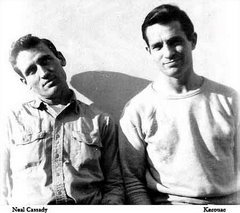
I understand through this poem why the Beat generation was also impressed. It has a very american atmosphere, almost like Whitmann. Woody Guthrie could've wrote it, or Bob Dylan.
It's as if you hear his voice all around.
It talks about indecissions, coffee, one-night stands, hotels, women that come and go, evokes gravity, includes dialogue, involves us in it...
And it's from 1917, you haven't read non of that until now. It's been considered the first modern poem in English language, and its key is the shape. Sharp and liquid at the same time.


Before this moment in time, it was clear the poet was creating the poem. Constructing it tear by tear. And in that exquisite context, the genious will make its way through 'til he bleeds to death.
The diference between now and back then, may be as simple as saying "I'm dying", instead of "my spirit's leaving me behind" for example. Both evoke death but have not quite the same meaning, do they? What's more true? It depends on the feeling when the time comes, and modern schemas are telling us about the moment in a complete exciting and realistic way. Without the flowery.


The reason why other writers hadn't gone that far before, may have been because of the reputation. Nobody wanting to be called vagrant, they rather smoke their cigarettes in large cafés, rather than crawl the streets looking for the soul and blood of the planet. Because that's not what you're supposed to do when you're an intelectual, is it? Because the rime, because the natural motifs... and sometimes coughing is better than day-dreaming. Going back to the experience, and not the platonic muse you may've been sure of having touched, but has she ever really touched you?

It's just another stile alright, but sometimes you rather scape from infinite tricks without a beginning or an end and try luck on the receiver's own contribution to finish things, or even fix them, been a little more humble. Eliot himself admited several times in public his insecureness, his doubdts. And didn't have a problem in asking a colleague such as Hayward to correct and help him out with the Four Quartets, for instance.


Maybe, and just maybe, that's what modernity's all about. Allowing the poem to flow by its own, becoming a puzzlement even for the writer. Leaving the instinct follow its way back home; heart rather than head. Letting it come if that's its destiny and not forcing it. Watching it pass by through the bar instead of on the paper without the fear of forgeting it even if makes you angry.
"Everything's poetry except for poetry", and the pain of its criticism.

New authors bet for simplicity without loosing the academic matters base. Much later think about the Beatles. Think about what Pop has made for the world: talking in a language everybody understands, accesible as the air, showing morality in the exact dose everyday-people will assume it.

But back to our issue, what we slowly suspect along the journey is that it's a mistake to look for the poem, to want it, just like been a poet, or even just been called one. To want to write a poem is the best way to destroy it. Or never give him birth. Non-born fire. In fact it's very pretencious to believe we're the owners of the poem and not the other way around, I mean, we're just a tool (Plato said). Ideas and inspiration are the ones that take possesion of us, we must never forget that. Like dreams. Like luck.


If we enter in the spiritual field, that's another tramp, but it gets even clearer: don't WANT anything, don't be so evil. Let it grow and come to you.
"You only know it once you've felt it" Bob Marley used to say.

You can't want brightness, nor understand it, nor envy it. We must stay human enough to accept whatever we already are. It's even tough work to learn from other, pathetic to copy, a crime to steal it.

It's something that once you know it is in you, you must just be patient and wait for it to posses you again. Like new friends come and incredible parties. The extraordinary can't be demanded if one's not lying to himself. If on top of all one is only guide by Truth, that is Art, that is Beauty.
That is shearing and Love, hope for tomorrow. Fresh air for magic.
Too many big words said together fastly, even, sometimes.

Poetry that'll come, when it is she that's waiting for you for once; poetry that's left to come.

That's what I feel about Modernity, and T.S Eliot had the intuition.


2 When to write your own Bible


The apparition of these faces in the crowd;

Petals on a wet, black bough.

"In a station of the Metro" by Pound

So much has  been said about Eliot's political and religious beliefs, that sometimes I wonder if we're not losing sight of what's important.

He never denied his right-wing view of the world, actually, he gave "Authoritarian conferences" in which a fear of lower classes' progress was undeniable; nor that he had convirted into anglicanism because he wanted that faith, not because he had felt it (in an interview with A.Pellegrini around 1927). But, in my opinion those two factors of his personality aren't such a strong part of his speech. Otherwise I wouldn't comprehend him myself, at least not as much.


And moving on from the years he worked side by side with Pound during the gestation of The Waste Land (1914-1922), - we must here remember one of The Cantos leitmotifs: “Beauty is difficult”- adapting their techniques to imaginists' theories on economy, specified visual effects and complete formal freedom; “whispering inmortality” and other remarcable exercises; metaphorically one and metonimically the other; scaping from romantic and melancolic shall-we-say boredome from before; suggesting new answers about harmony in this hated and poisoned Europe; with an extremelly cultivated education when it comes to empiric and not pretended experiences, being part of the neorealism, guide by “art in less is more”, privacy mixed on elaborated emotion, etc; and looking for the most minimal and exact expression, in the sense that every single word written was as necessary as space and time, as concise as a brand new typewriter's calligraphy and, above of all, as natural and imaginative as you can get... 

This time, our poet dares to move on from one anglosaxon country to another, to expel his demonds on a society that has truely disappointed him (during his lifetime were the two World Wars) and a finished marriage with Vivienne that lasted eighteen years, on Four Quartets.


3 Four Quartets itself

Technically speaking, we may consider the central skeleton of this extended text, a meditation about time and existance. And maybe go or at least look beyond/through it.

According to Esteban Pujals it would generally be structured this way: passing of time and the eternal moment - adult experience and its insatisfaction - a sort of purgatory where we get rid of our material/earthly needs - invocation of a divine intervention - and finally, finishing the poem on a close dependence to perfection, in order to achieve religious health. To fall asleep at night.


It's presented in a rather impersonal form which allows the use of our own representations, if it wasn't because of fantastical images already have been objectically insinuated together with beauty in search for that magical moment, and everythings floating around.


When it comes to style, that sinister irony tipical from the conservatism standards fades away as you open the book by any page and read something like: In the beginning is my end. In sucession
Houses rise and fall, crumble are extended,
Are removed, destroyed, restored, or in their place


Sometimes the use of extravagant icons can take us to confused places. We must count on the fact that even crazyness, illness, hunger, will be there for a reason. Everything's there on purpose. A catastrophe may be deliberated, in order to create something else. Those mortal remains are there to keep us alert.


It also make us think of all the lifes we chose not to live. What would've happened if...
Now it's useless to think about it, but still, maybe that can be called Beauty.

There's a constant feeling of overconsciense, as we felt with Dostoyevski's characters (which can be consider a disease: analyze too much the things that surround us). But that's in part the roll a writer suits himself in. He tries to control everything for a moment, for an electrical moment feeling eternal, with a cosmic vision. Being God and learning how to die. That's the only way to find Wisdom.

The frustration comes when "here you have your stupid poem, now what? what's next!"

It's painful the fact that life continues once you've already have reached some limits. You've felt Happiness and you knew in the very moment you were being blessed by that fortune.

Ocassionally Eliot's thread is almost invented or nonsense, but it must be there to follow the flow,
even if it's just by instinct.


The life of the words is their own musicallity, their destiny to die, such as ours, and every living criature.
Questions are asked to the wind, as if it was a riddle: there's a still point in the middle of all this ridiculous world spinning round, what is it? For me it's Thought.

There are astral aspirations which can be confused with some old white-bearded God, and that could be what was in Eliot's mind, but for me, he's going deeper into metaphysical matters. I relate it more on Buddhism and Taoism than a real Christian answer/argument(s).
He wants to continue 'til the end, and that's very dangerous, and the headaches, and the loneliness;
but that's why we're here for.
The moral message is commonly at the end of the poem.

And the more curious you dig, the faster you get burned.

Those are the things I think about when I see (in context):


To look down into the drained pool 

(looking into ourselves and probably seeing how empty we still are)


[...]Except for the point, the still point

there would be no dance, and there is only the dance 

I can only say, there we have been: but I cannot say where.
(love, peace, the miracle / you have to have felt it to understand it)

To be conscious is not to be in time
[…]
Only through time time is conquered.
(we're doomed to isolation)


Descend lower, descend only

Into the world of perpetual solitude

World not world, but that which is not world

(loneliness when you've reached on your own a spiritual point, and you know it)


And all is always now
(obsession about the present, and controling it at last, and transform it as we wish
but would it still be the present?)


Valuation of all we have been. We are only undeceived
Of that which, deceiving, could no longer harm.
(we must look through appearances)


The dancers are gone under the hill

(Sadness is here again)


[...] there is yet faith

But the faith and the love and the hope are all in the waiting

('til magic decides to come back, even if it's not really to stay
and the non-existing Forever, except for Death, as we now know of)


In order to arrive at what you do not know
You must go by a way which is the way of ignorance.

In order to possess what you do not possess

You must go by the way of dispossession.

In order to arrive at what you are not

You must go through the way in which you are not.

And what you do not know is the only thing you know

And what you own is what you do not own

And where you are is where you are not.

(this is a clear refference on his knowledge and admiration for the learnings of Lao-Tsé

oriental philosophies)


And the ragged rock in the restless waters,
Waves wash over it, fogs conceal it;
On a halcyon day it is merely a monument,

In navigable weather it is always a seamark

To lay a course by: but in the sombre season

Or the sudden fury, is what it always was.

(authentity will resist, truth can take anything, even the end of the world, or the civilization)


I sometimes wonder if that's what Krishna meant
[...]
That the future is a faded song
[...]
Pressed between leaves of a book that has never been opened.
(this can be considered religious, no doubdt, but as well deals with the misteries of time
slow things may confuse us, because we think they're here to stay
and the poet is the bird that answers to that song, he think he's listened a long time ago)


Along the way through the voices of children in the garden (Burnt Norton), the vision of a philosophical sunset (East Coker), the metaphors of life accused by rivers and misterious seas (Dry Salvages) and finally, the vanishing energy and old age (Little Gidding) we enjoy, as clear as pure, Eliot's capacity to intensify and celebrate -in spite of all- Reality.


4 References

- KENNER, H., The Pound Era, London, Faber, 1971.


- LEVENSON, M. A Genealogy of Modernism, Cambridge, Cambridge University Press, 1984.


- PUJALS, E., La poesía inglesa del siglo XX, Cátedra, Madrid, 1980.


- ELIOT, T.S, Four Quartets, Cátedra, Madrid, 1987.


Freely (Devendra Banhart)

http://www.goear.com/listen.php?v=5bd7fe4